Edge Computing Reshapes Real-Time Mobile Analytics Capabilities
Written by Iris Koch · Oct 16, 2026

Edge Computing Reshapes Real-Time Mobile Analytics Capabilities
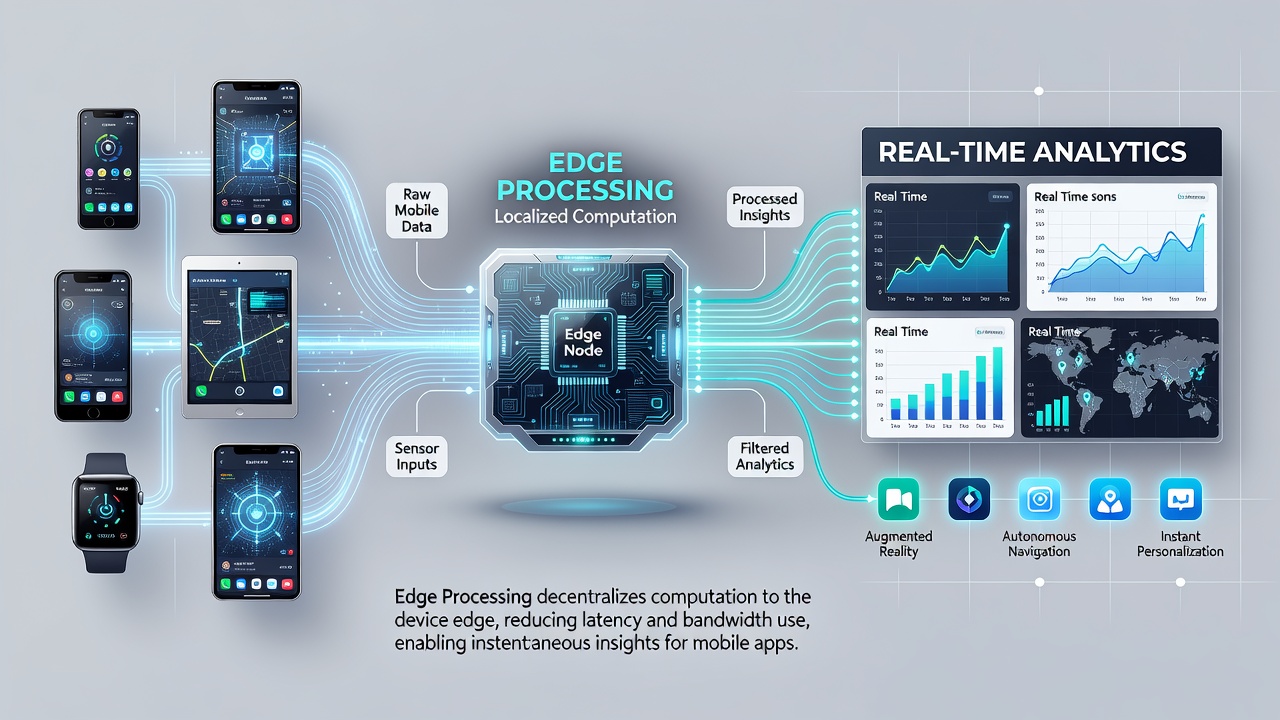
Edge processing moves computation closer to mobile devices, cutting the round-trip time that once sent every data packet back to centralized servers, and this shift has accelerated real-time analytics in applications ranging from navigation tools to health monitors. Data shows that latency drops from hundreds of milliseconds to under 20 in many urban deployments, which lets apps generate immediate insights while users remain on the move. Researchers at institutions across Europe and North America have documented how this architecture handles sensor streams from smartphones without overwhelming core networks.
Core Mechanics Behind the Transformation
Mobile applications now run lightweight analytics engines on local gateways or even on the handset itself, processing GPS coordinates, accelerometer readings, and biometric inputs on the spot before any summary reaches the cloud. This approach uses containerized microservices that activate only when thresholds are crossed, so an exercise tracker can flag irregular heart rhythms within seconds rather than waiting for batch uploads. Figures from industry reports indicate that 68 percent of new mobile analytics deployments in 2025 incorporated at least partial edge nodes, with projections pointing to further growth by October 2026.
Network operators have rolled out multi-access edge computing platforms that sit inside radio access networks, giving developers direct access to radio metrics and user location data without traversing long-haul fiber. Those who studied these rollouts note that bandwidth savings reach 40 percent on average because only aggregated results travel upstream. Yet the same systems must still reconcile with privacy rules that vary by jurisdiction, including frameworks issued by the European Union Agency for Cybersecurity and guidance from Canadian federal regulators.
Practical Applications Across Sectors
Logistics firms embed edge analytics inside driver apps so route optimization happens locally when connectivity flickers, then syncs refined predictions once signals return. One deployment covering 12,000 vehicles in the Asia-Pacific region recorded a 22 percent reduction in fuel consumption after switching from pure cloud pipelines. Retailers similarly use edge nodes in shopping apps to analyze in-store movement patterns and deliver personalized offers before customers exit the aisle.
Healthcare applications process continuous glucose readings or ECG traces on wearable gateways, triggering alerts when anomalies appear instead of streaming raw waveforms constantly. A collaborative project between Australian universities and regional health services demonstrated that edge-filtered alerts reached clinicians 11 seconds faster on average than cloud-only equivalents. Gaming studios have adopted the same pattern to synchronize multiplayer states across nearby devices, reducing perceived lag during live events that draw thousands of concurrent players.
Technical and Regulatory Considerations
Security models now place encryption and access controls at every edge node, because data never leaves the local trust boundary until it has been sanitized. Standards bodies such as the National Institute of Standards and Technology have published reference architectures that guide developers on isolating workloads while still allowing federated learning across sites. Observers tracking adoption note that compliance teams review these architectures early in the design phase to avoid retrofits later.
Hardware diversity presents another layer: some handsets run dedicated neural processing units, while others rely on general-purpose CPUs that share cycles with the main operating system. Developers therefore profile power draw and thermal limits before pushing analytics tasks to the device, and they fall back to nearby edge servers when handset resources are constrained. Data from field trials shows this hybrid strategy keeps battery impact below 8 percent for continuous monitoring tasks.
Future Trajectory Through 2026
By October 2026, 5G-Advanced and early 6G testbeds are expected to add deterministic networking slices that guarantee sub-5-millisecond delivery between edge nodes and handsets. This capability will support new classes of analytics, such as real-time AR overlays that adjust to crowd density or environmental sensors. Industry associations tracking spectrum policy across multiple continents continue to coordinate on spectrum harmonization so that edge services function consistently when users cross borders.
Conclusion
Edge processing has shifted the center of gravity for mobile analytics from distant data centers to locations that sit within a few network hops of each user. The result is measurable gains in responsiveness, reduced backhaul load, and new possibilities for applications that must act on live data streams. Continued coordination among standards organizations, network operators, and academic research groups will determine how quickly these capabilities scale while meeting privacy and security requirements across regions.