Firmware Adjustments Enhancing Battery Performance in Portable Computing Devices
Written by Iris Koch · Sep 18, 2026

Firmware Adjustments Enhancing Battery Performance in Portable Computing Devices
Portable computing hardware relies on firmware layers to regulate power draw across processors, memory modules, storage drives, and wireless radios, and these adjustments occur through mechanisms like dynamic voltage scaling and selective component shutdowns that activate during idle periods. Manufacturers embed these controls in UEFI and BIOS environments where they interface directly with operating systems to balance performance against energy use.
Core Mechanisms Behind Firmware Power Controls
Power states defined in standards such as ACPI allow firmware to transition CPUs between C-states and GPUs between similar low-power modes, while sensors report temperature and load data that trigger immediate frequency throttling when thresholds are crossed. Data from industry reports shows these transitions can reduce average power consumption by measurable percentages on multi-core systems used for everyday tasks like document editing and web browsing.
Storage firmware also contributes through features that spin down mechanical drives or place solid-state drives into slumber states after inactivity timers expire, and network interface controllers receive similar treatment when firmware disables unused antennas or lowers transmission power during light data transfers. Observers note that coordinated control across these subsystems prevents unnecessary wake-ups that would otherwise drain reserves faster than isolated optimizations achieve.
Recent Developments and Implementation Patterns
In September 2026 updates rolled out by several hardware vendors introduced refined sleep-state scheduling that prioritizes deeper idle modes for background processes without interrupting foreground applications, and these changes followed laboratory tests conducted across multiple device models. Researchers at academic institutions documented improvements in continuous runtime on standardized workloads after applying the revised firmware images.
One case involved enterprise laptops where firmware patches adjusted memory controller timing to enter self-refresh more aggressively during brief pauses, and the resulting measurements indicated lower overall energy expenditure across eight-hour work sessions. Those who examined before-and-after logs found the gains stemmed from tighter integration between firmware timers and operating-system power policies rather than hardware redesigns.
Measurement Approaches and Validation Data
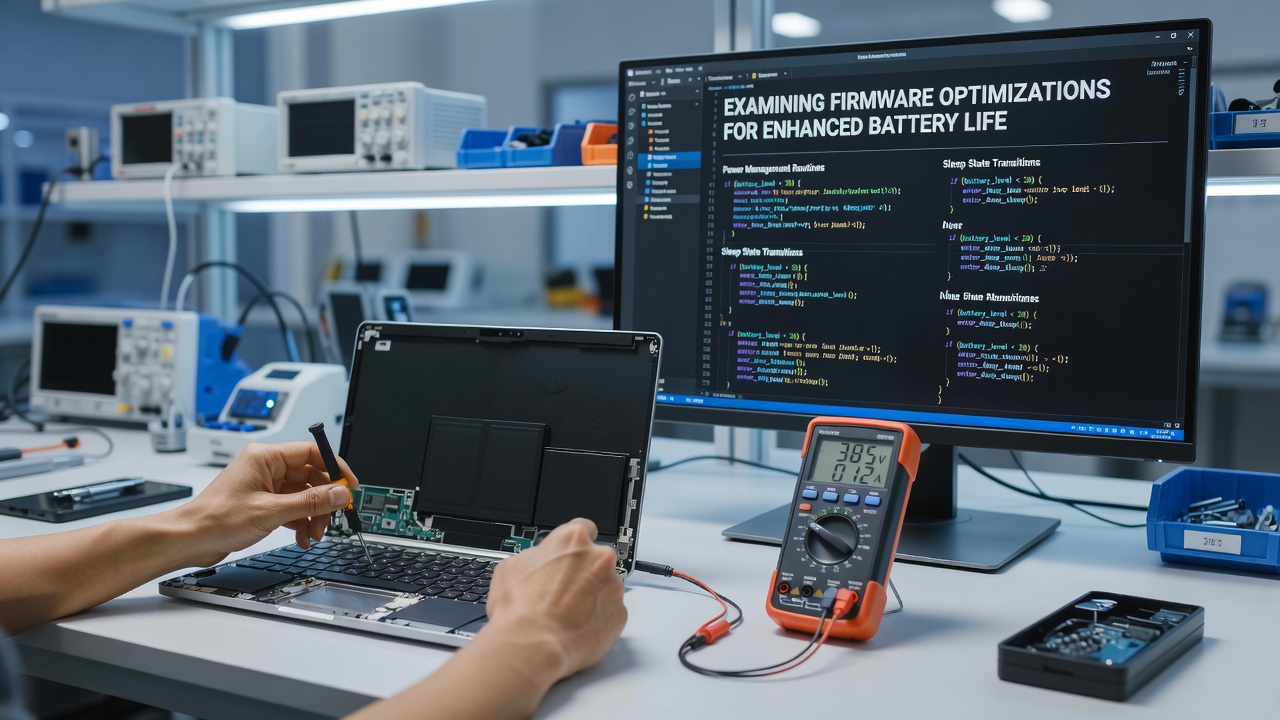
Testing protocols combine synthetic benchmarks with real-world usage traces to quantify battery impact, and figures from such evaluations reveal consistent patterns when firmware enables adaptive charging limits that cap capacity at 80 percent during extended plugged-in periods. Government agencies including the US Department of Energy have published guidelines that reference firmware-level controls as part of broader efficiency frameworks for consumer electronics.
Additional validation comes from European research consortia that track field data from deployed fleets, where aggregated logs show seasonal variations in battery degradation rates tied partly to firmware update cadence. Canadian studies on mobile workstations further confirm that selective disabling of unused peripheral controllers during travel scenarios extends operational windows between charges.
Challenges in Deployment and Compatibility
Compatibility issues arise when firmware changes interact with third-party drivers or legacy software that expects constant hardware availability, and troubleshooting often requires rollback options built into update utilities. Observers note that phased rollouts across device populations allow manufacturers to monitor telemetry for unexpected power regressions before wider distribution occurs.
Security considerations also factor in because firmware responsible for power management must remain protected against unauthorized modifications that could alter energy profiles or introduce vulnerabilities, and industry groups advocate signed update mechanisms to maintain integrity throughout the device lifecycle.
Conclusion
Firmware optimizations continue to serve as a primary avenue for extending battery endurance in portable hardware because they operate at the lowest system levels where direct hardware control remains possible. Ongoing refinements in state management, sensor integration, and cross-component coordination produce measurable efficiency gains documented across laboratory and field settings, while validation from multiple geographic sources supports their role within larger energy-conservation strategies.